
Tractors and Their Impact on Farming in the 1900s
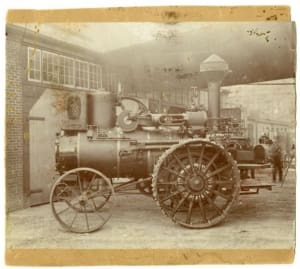
LEFT: Steam-Powered Tractor, 1890-1910. Image source: https://collection.mndigital.org/catalog/mhd:2876#?xywh=-2539%2C-729%2C9478%2C5765
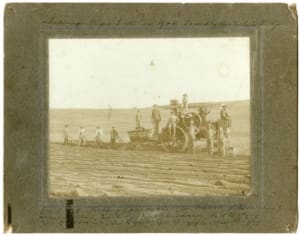
RIGHT: Turning Over Prairie Grass, 1904. Image source: https://collection.mndigital.org/catalog/p16022coll24:14#?xywh=-1490%2C-216%2C6172%2C3754
Swedish immigration to the United States and Scandia is closely tied to the development of American agriculture. In the mid- to late-1800s, thousands of Swedish families settled in the Upper Midwest, drawn by the opportunity to recreate the agrarian lifestyle they had left behind.
Life for these early pioneers involved backbreaking labor. They had to clear dense forests, pull out tree stumps, and turn over thick prairie sod with deep roots. This required tremendous physical work, even with the help of horses and oxen.
However, the agricultural landscape of Scandia and surrounding Swedish-American communities changed significantly when tractors were introduced in the early 1900s.
Tractors revolutionized farming in Scandia and throughout Minnesota by dramatically increasing productivity and eliminating the grueling physical demands placed on immigrant farming families. Mechanization allowed Swedish-American farmers to expand their acreage, greatly reducing the time they needed to plow, plant, harvest, and manage their large livestock operations.
In Scandia, tractors became vital in transforming subsistence-level homesteads into prosperous, viable farms. A variety of vintage and contemporary tractors will be at Gammelgården during Taco Daze on Saturday, September 12th, from 10-4 to illustrate this change in farming practices.
Come to the Museum to see the tractors and inside the historic barn that was built in 1879 to view historic farm tools. While you are at Gammelgården, visit the Welcome House (the big red building) to see displays of historic shoemaking tools, as well as clothing and textiles from the 1850s-1950s.

